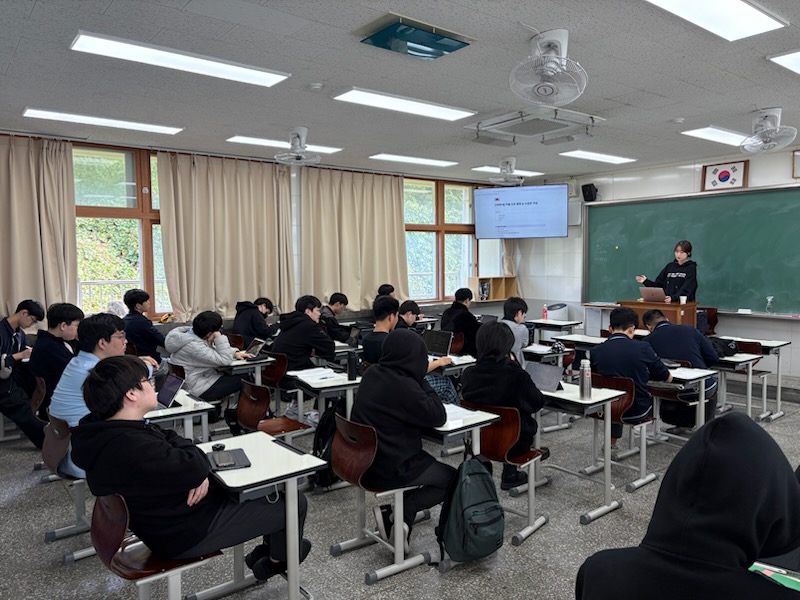
I spent a lot of time thinking about how to keep the students interested and what would be most useful to them over ten 110-minute sessions. Teaching programming syntax from scratch in such a short period did not seem like the best way to help them make something meaningful, so I designed the course around building with AI tools.
I introduced core AI concepts, prompt engineering, vibe coding, and hands-on exercises with tools such as LangChain and RAG. Rather than asking students to accept generated code as it was, I taught them how to write clearer prompts, inspect the results, identify what needed to change, and revise the code until it became a useful working product.
For their individual projects, the students created personal homepages. They then worked in teams to plan and build a service, which they presented at the school festival. Seeing them turn their own ideas into things they could demonstrate helped me understand how much the structure of a class matters for sustaining curiosity and confidence.
Through this experience, I found it deeply rewarding to share what I knew and watch the students turn that knowledge into projects of their own. I also learned to choose the depth and pace of technical material around the learners in front of me, explain why a tool behaves the way it does, and give them enough room to judge its output and make the project their own.