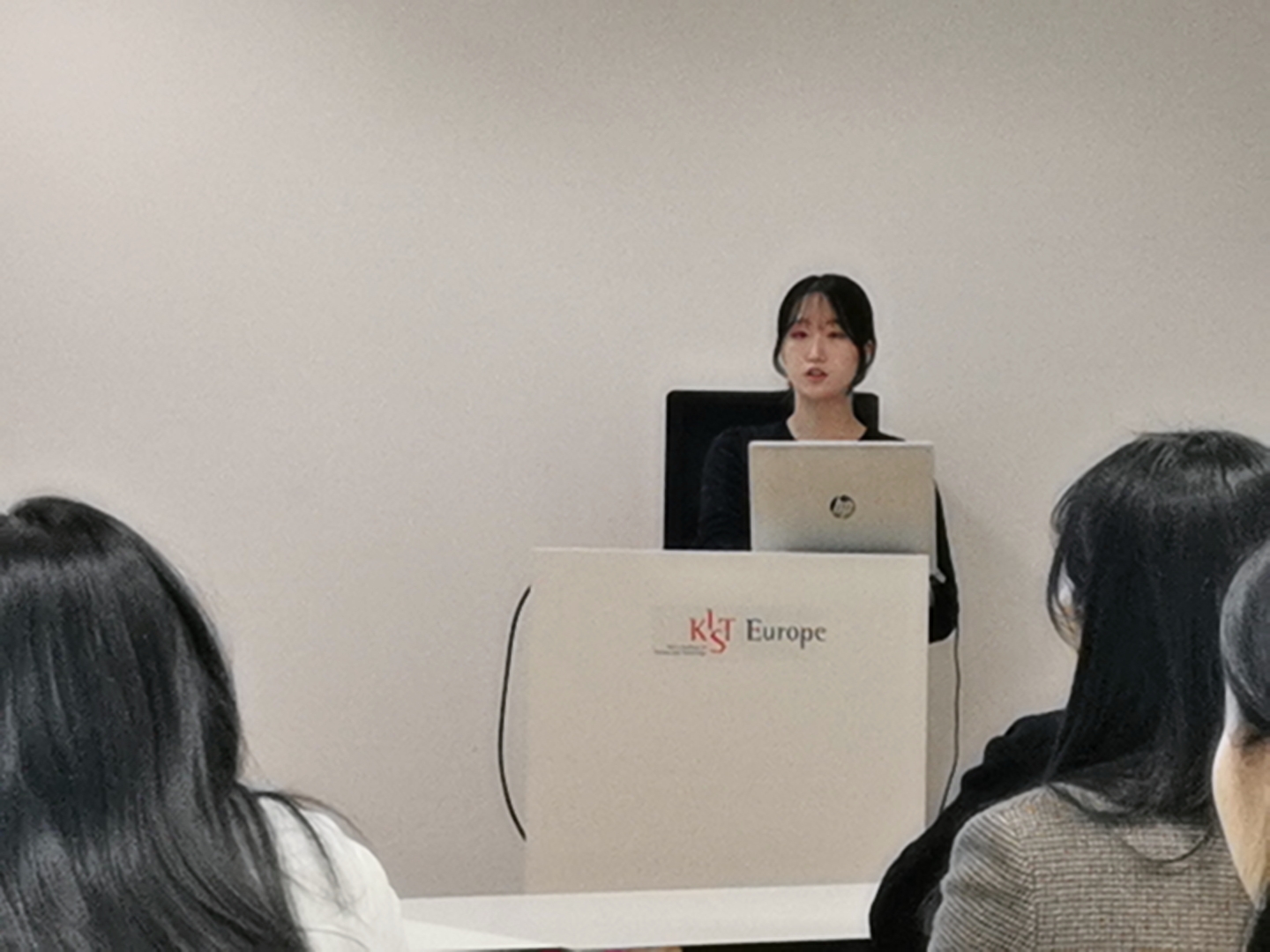
During my six-month internship in the Planning and Coordination Division at KIST Europe, I worked under the supervision of Dr. Juyong Yoon. My project began with a practical problem: researchers needed a faster way to find relevant Horizon Europe projects. The data was public, but it was spread across 2,048 XML files, each with roughly 1,000 lines, so finding useful information often meant opening files one by one.
I started by asking what researchers actually needed from the tool. They wanted something free to run, grounded in the source data, available in both Korean and English, and simple enough to use without a complicated setup. Based on those needs, I planned a retrieval-augmented generation assistant.
I built the retrieval pipeline in Python with LangChain, Hugging Face, Gemma 2 2B, and a vector store. It retrieved relevant documents using cosine similarity, passed them to the model, and displayed answers in a Streamlit interface. I also added project links and tables when they made the results easier to compare.
I shared early versions with researchers and kept revising the system based on their feedback. A recurring request was to understand where each answer came from, so I changed the interface to make retrieved sources easier to inspect and made the assistant respond more cautiously when the evidence was weak.
This was the first time I saw clearly that a technically correct system is not automatically a useful one. I learned to begin with the users’ real task, watch how they use the system, and keep improving it until the interface and the underlying model work together for their needs.